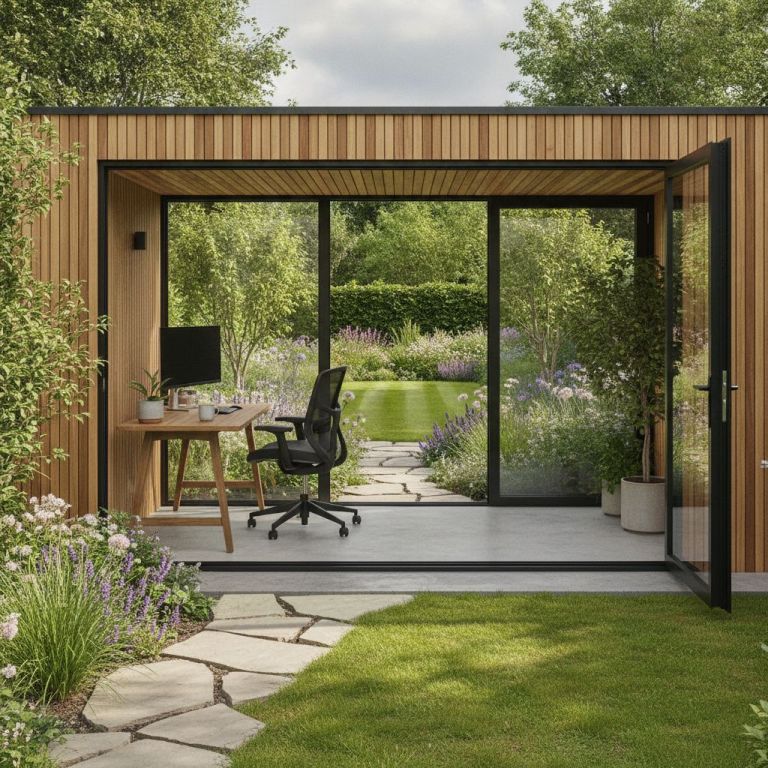
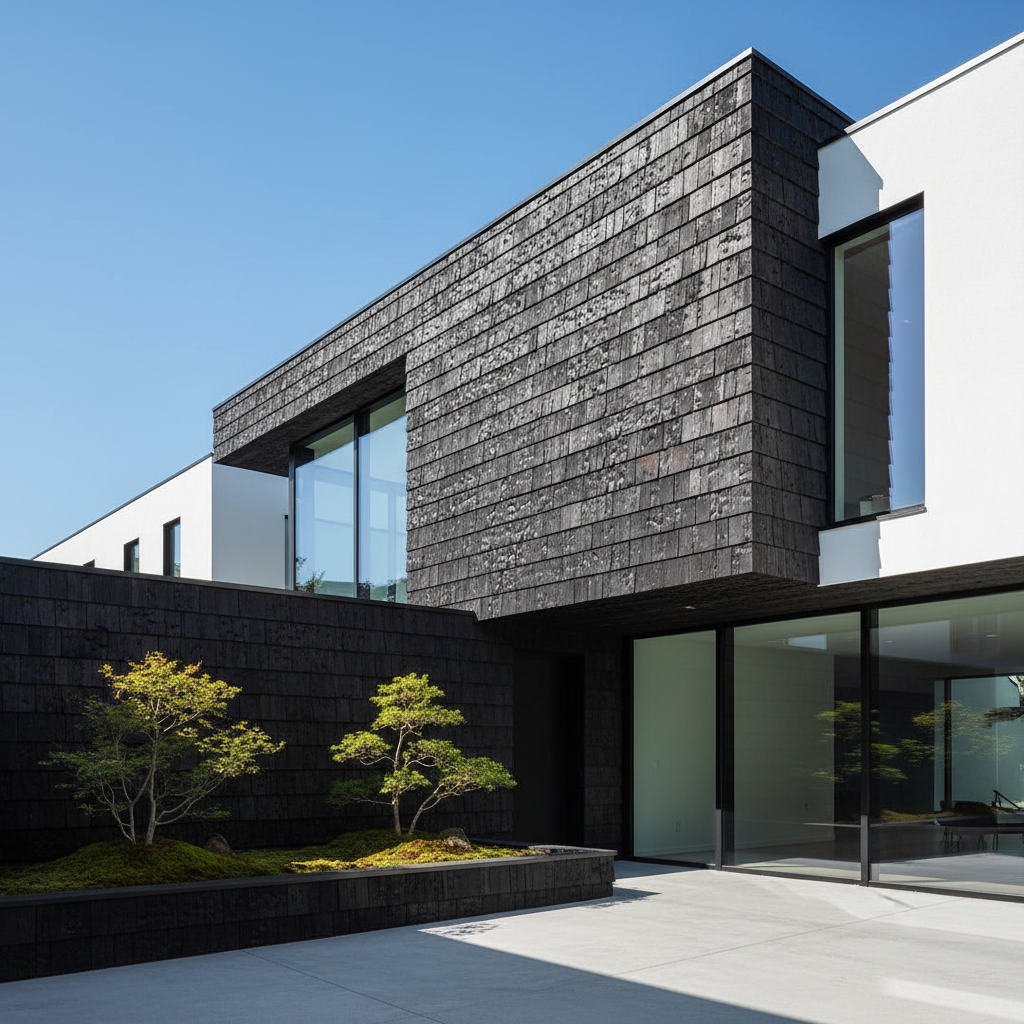
Oak and ThermoWood occupy a similar space in a specifier’s head — both are premium cladding choices, both deliver decades of low-maintenance service, both arrive with a deep, warm tone. But they get there by completely different routes. Oak is hardwood pedigree built up over decades in the forest; ThermoWood is engineered durability created in three days inside a steam chamber. Below is the honest comparison.
Headline numbers
| English / European Oak | ThermoWood (Thermo-D Pine) | |
|---|---|---|
| Durability Class | Class 1–2 (heartwood) | Class 1–2 (after treatment) |
| Density | ~720 kg/m³ | ~480 kg/m³ (post-treatment) |
| Initial colour | Honey-gold to mid-brown | Uniform chocolate-brown |
| Lifespan untreated | 40–60 years | 30 years |
| Movement after install | Significant in first 18 months | Very low (40–50% less than untreated) |
| Typical UK price (£/m²) | £85–£140 | £55–£85 |
| Carbon-stored credentials | Locally grown options available | FSC pine + low-energy process |
The case for Oak
Unmatched durability
Oak cladding is the longest-lasting external timber we sell. Class 1 heartwood will silver gracefully on a UK elevation for 50+ years with literally zero intervention — many medieval barns are still standing in their original oak. If you’re designing for a 60-year building life and want to specify once, oak is the answer.
Heritage and aesthetic depth
Oak’s grain figure — medullary rays, ripple, occasional silver lace — is unique among the cladding hardwoods. It also weathers asymmetrically: the south face goes silver while the sheltered north face holds gold for years. On a country house or barn conversion, that texture and movement is the whole point.
Local sourcing is possible
Most of our oak is European; some lines are British. The carbon embedded in a locally-sawn oak board is genuinely low and the timber-mile story is one of the easiest sustainability arguments to make to a planning officer.
Honest downsides
- Tannin bleed — oak weeps black-brown tannins onto whatever’s below it for the first 12–18 months. Render, white-painted reveals and pale paving will need protecting during commissioning.
- Movement — even air-dried oak will cup and twist if pin-fixed. Cladding must be secret-fixed or face-fixed with stainless screws and oversize holes.
- Weight — at ~720 kg/m³ oak is heavy. The substrate behind it (battens, breather membrane, fixings) must be specified accordingly.
- Lead time — kiln-dried oak in cladding profiles is not always stock; allow 2–4 weeks on bespoke runs.
The case for ThermoWood
Engineered stability
ThermoWood is what happens when you bake softwood at 212°C in oxygen-free steam for ~3 days. The hemicellulose breaks down, the moisture-binding sites are stripped out, and the resulting board is around 40–50% less hygroscopic than untreated softwood. In practice that means very little expansion and contraction over the seasons — fewer cracked joints, less cupping, and a much easier fit. The full process is explained in our guide to what ThermoWood is.
Hardwood durability at softwood prices
ThermoWood cladding behaves like a Class 1–2 hardwood in the wall but is priced like a quality softwood. You’re paying roughly 60–70% of equivalent oak per square metre for a comparable lifespan (3 decades vs 4–6).
Uniform, predictable colour
Where oak is variable and full of character, ThermoWood is uniform and contemporary. The chocolate-brown runs all the way through the board, so cuts, drill holes and end-grain don’t reveal a paler core. For dark contemporary facades it’s hard to beat.
Honest downsides
- It silvers like everything else — if you want to keep the dark brown long-term you need a UV-blocking oil refreshed every 18–36 months.
- Reduced mechanical strength — the heat treatment makes the timber more brittle. ThermoWood is not a structural material; it is cladding only.
- Slightly faded “natural” credentials — yes, it’s wood. Yes, the process is chemical-free. But it is an industrial product made in a Scandinavian factory, not a hand-sawn local board.
When to choose which
Choose Oak when…
- You want a 60-year design life with zero maintenance.
- Heritage, planning context or building style demands it.
- Tannin bleed during commissioning is acceptable.
- Budget can stretch to £100+ per m² of timber alone.
Choose ThermoWood when…
- You want a contemporary dark facade with consistent colour.
- Dimensional stability is critical — for instance, very long boards or large feature panels with no expansion gaps.
- Budget needs to land between £55 and £85 per m².
- The project is in a coastal or wet location where untreated softwood would fail.
The hybrid answer
On a few projects we’ve seen specifiers split the difference — oak on the principal elevation (the architectural feature), ThermoWood on the rear and gables (the workhorses). Both silver to a similar grey-bronze within 4–5 years, and the cost saving over an all-oak job easily covers the higher fitting rate of the hardwood.
Want samples?
We send free A4 cladding samples anywhere in the UK. Email us with your project details — even better if you can tell us the elevation orientation and approximate square-metre area, so we can quote properly delivered.