The honest short answer is: £55 to £180 per square metre installed, depending on species, profile and fitting complexity. The longer answer — the one that helps you actually budget a project — is below. Every number here is a live UK rate from Q2 2026; we update this guide each year.
The full cost stack, line by line
| Line item | Typical cost (£ per m²) | Notes |
|---|---|---|
| Cladding boards (material) | £35 – £140 | Heavily species-dependent — see breakdown below |
| Treated batten counter-grid | £6 – £10 | 38×38 or 50×50 vertical + horizontal grid |
| Breather membrane | £3 – £6 | Vapour-permeable, UV-stable type |
| Stainless steel fixings | £3 – £7 | A2 minimum; A4 if coastal |
| Insect mesh + cavity closers | £2 – £4 | Top, bottom, around windows |
| Labour (fix-only) | £25 – £55 | Depends on profile + access |
| Scaffolding (if needed) | £8 – £20 | Spread over project area |
| VAT | 20% | On materials and labour |
Add it all up and a straightforward single-storey gable in larch lands around £80–£100/m² installed; an oak feature wall on a two-storey south elevation can comfortably hit £170/m². Below we break each line item down properly.
Material cost by species
Treated softwood — £28 to £42/m²
The honest budget choice. Pressure-treated redwood in feather-edge or shiplap profile is what you cladding-clad cheaply. Lifespan 20–25 years assuming proper detailing.
ThermoWood — £55 to £85/m²
ThermoWood hits the sweet spot for value — hardwood-grade lifespan at upper-softwood prices.
Canadian Larch — £35 to £60/m²
The default UK contemporary cladding. Candian Larch is genuinely good value for what you get — A-grade boards, naturally Class 3 durable, no treatment needed.
Western Red Cedar — £55 to £95/m²
Cedar commands a 30–40% premium over larch because of its native rot resistance and easier-handle weight.
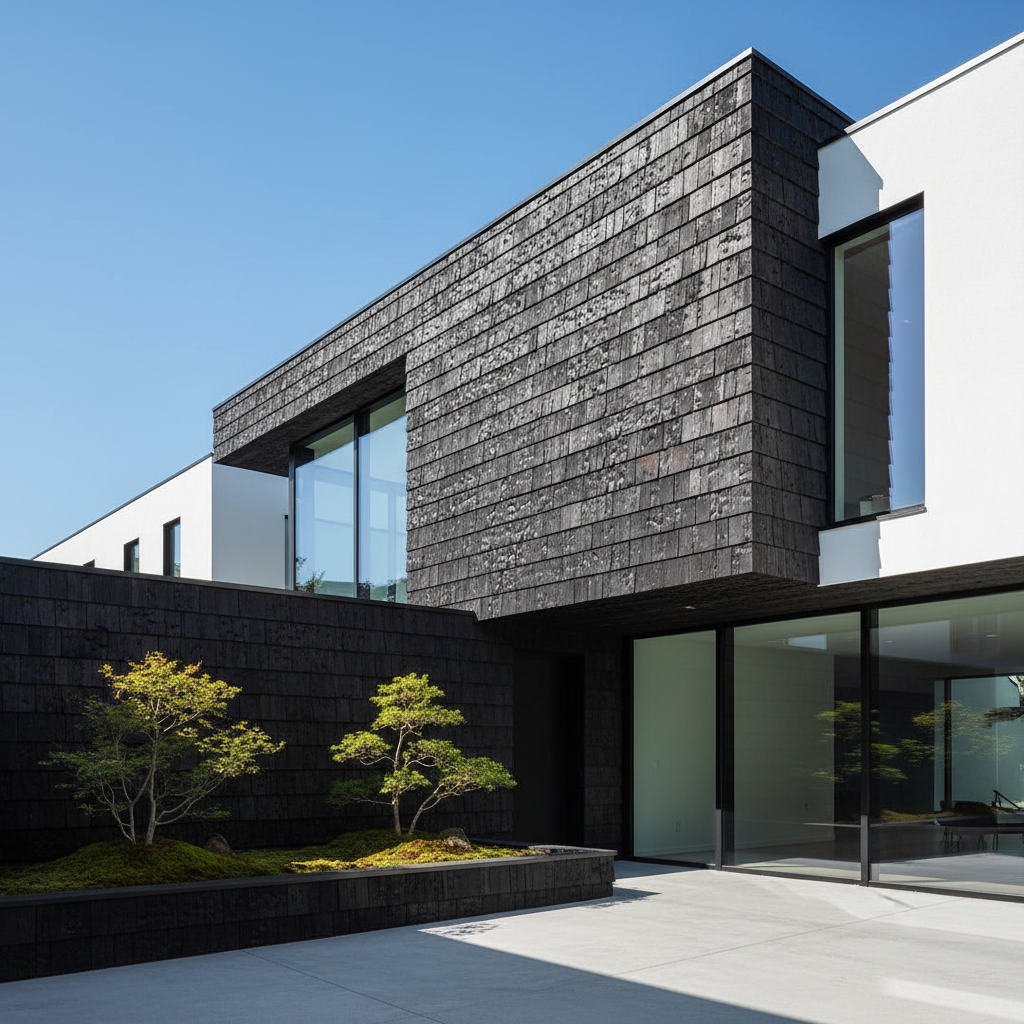
Charred (Shou Sugi Ban) — £65 to £110/m²
Charred larch or cedar sits above its untreated equivalents because of the extra processing — but it pays back in negligible maintenance for decades.
Sapele — £75 to £115/m²
The most affordable Class 2 hardwood. Sapele cladding gives you the deep red-brown of mahogany without the price tag.
Oak — £85 to £140/m²
Oak is the longest-lifespan timber on the list and prices reflect that. Air-dried is the standard; kiln-dried adds 15–20%.
Installation cost: what drives labour
Labour is the line where projects vary most. Three things move the price:
- Profile complexity. Hit-and-miss takes longer than shadow gap; vertical secret-fix is slower than horizontal nail-fixed. Allow 25% extra labour on hidden-fix profiles vs nail-fixed feather edge.
- Window and door cutouts. Every opening adds an hour or two of careful trimming and beading. A facade with five windows fits roughly 20% slower than a blank gable.
- Access. A single-storey rear extension fits at 8–10 m²/day. A two-storey gable needing a scaffold tower or proper scaffold drops to 5–6 m²/day.
Hidden costs that catch people out
- Breather membrane upgrades. Standard membrane is fine but UV-stable, black-coloured types add £2–£3/m² and prevent that “white showing through the joints” effect on shadow-gap and rainscreen profiles.
- Cavity closers and insect mesh. Mandatory under modern building regs; often forgotten in DIY costings.
- Corner trims. Either pre-machined corner mouldings or mitred boards both add labour and material — budget for them.
- Disposal. If you’re stripping existing cladding or insulated render, skip hire is £200–£400.
- Building control fees. Replacement cladding above 18m needs Class B-s3,d2 minimum (Approved Document B). Get sign-off costs into your budget early.
Where to save money safely
- Buy direct from a specialist supplier. Builders’ merchants typically markup 25–40% over wholesale; specialist timber merchants like ourselves run on much tighter margins.
- Stick to stock profiles. Bespoke milling adds 15–30% and lead time. There’s almost always a stock profile that fits the design intent.
- Order long lengths. 5m boards waste 5–8% in offcuts; 3m boards waste 12–15%. The per-metre price difference is usually less than the saving.
- Fix in pre-stained, not on-wall. Coating boards before fitting is significantly faster than coating them in place with brushes and is the standard professional approach.
Where NOT to save money
- Fixings. Galvanised screws will stain the wood with black streaks within 18 months. Always specify stainless A2 (inland) or A4 (coastal).
- Batten counter-grid. Skipping the secondary batten layer to save £5/m² will rot your cladding from the back inside a decade. Don’t.
- Class B fire treatment when needed. If the building height or boundary distance requires it, it’s a legal requirement, not a value-engineering opportunity.
Get a proper delivered quote
Every project is different. Send us a sketch or photo of the elevation, the species you’re considering and the approximate area and we’ll come back with a delivered price the same day — no obligation. Browse the full timber cladding range to see live per-m² prices on our stock profiles.